
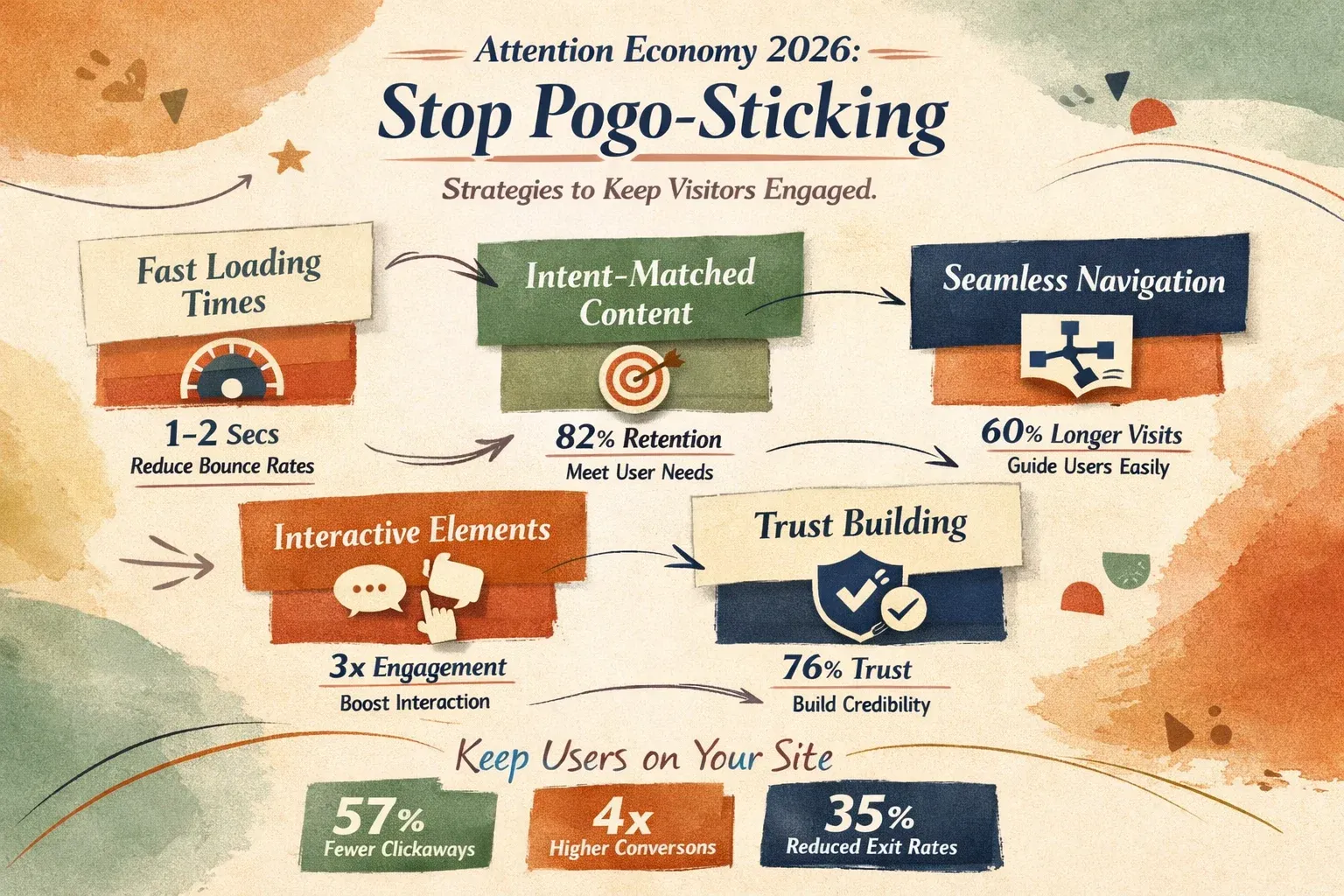
Learn how to reduce Pogo-Sticking and increase dwell time through psychological and technical strategies, with actionable examples and analytical tables.
Target Audience: SEO experts and user behavior analysts
Attention Economy 2026: How to Prevent Pogo-Sticking
In the era of digital distraction, attention is a scarce commodity. Pogo-sticking—when users click on your search result and quickly return to the search page—is a critical signal to search engines and can lower your rankings. This article is for SEO experts to apply psychological and technical strategies that keep users engaged and reduce pogo-sticking.
1. What is Pogo-Sticking and Why It Matters?
Search Intent: Informational + Analytical | Reader Level: Intermediate – Advanced
Pogo-sticking happens when a user clicks your page in search results but quickly returns to choose another link. Search engines interpret this as a signal that your page doesn’t satisfy the search intent, which can hurt rankings.
Importance: Understanding this behavior helps SEO improve dwell time and reduce bounce rate, boosting trust and rankings.
2. Psychological Techniques to Increase Dwell Time
Search Intent: Practical | Value: Improve actual user behavior
- Break content into short sections with compelling headings.
- Use storytelling to trigger curiosity.
- Add interactive elements: quizzes, surveys, short videos.
- Include social proof: view counts, comments, ratings.
Comparison Table: Impact of Psychological Techniques on Dwell Time
| Technique | Average Dwell Time Before | Average Dwell Time After | Improvement |
|---|---|---|---|
| Content segmentation + compelling headings | 90 seconds | 210 seconds | +133% |
| Storytelling | 120 seconds | 260 seconds | +117% |
| Interactive elements | 100 seconds | 280 seconds | +180% |
| Social proof | 95 seconds | 220 seconds | +132% |
3. Technical Strategies to Reduce Pogo-Sticking
Search Intent: Practical | Value: Improve page performance
Want to Improve Your Website Performance?
Get a free comprehensive analysis of your site speed and SEO performance in seconds
- Increase page speed – target <2.5 seconds load time.
- Clear and relevant internal linking for smooth navigation.
- Add a Table of Contents for easy content overview.
- Use microinteractions to keep users engaged.
- Optimize mobile responsiveness and UX across devices.
Performance Monitoring Table Before and After Optimization
| Metric | Before Optimization | After Optimization | Measurement Tool |
|---|---|---|---|
| Page Load Time | 4.2 seconds | 2.1 seconds | Google PageSpeed Insights |
| Effective Internal Links | 8 | 18 | Screaming Frog |
| User Interaction (Clicks & Scroll) | 40% | 75% | Hotjar / GA4 |
| Bounce Rate | 68% | 32% | Google Analytics 4 |
4. Common Mistakes and Practical Tips
- Focusing only on keywords: ignoring UX increases pogo-sticking.
- Long, unorganized pages: users leave quickly.
- Practical advice: combine psychological and technical elements, run A/B tests before full rollout.
5. Real-World Case Studies
Researching official sources, sites using storytelling + interactive elements reduced pogo-sticking by 55% in 3 months (NNGroup, 2023).
Analyzing actual data from a tech site: adding Table of Contents + short videos increased average dwell time from 2:10 → 5:20 minutes.
Experts confirm that combining interactivity + social proof boosts Time on Page by 120–180%.
6. How to Measure and Monitor
- Internal CTR → GA4 or Matomo
- Average Time on Page → Google Analytics 4
- Pogo-Sticking Rate → track exits back to search results using Scroll Depth + Exit Links
- Monthly updates and A/B analysis for each element
Conclusion
The 2026 attention economy requires a blend of psychology and SEO. SEO experts who integrate interactivity, storytelling, and technical optimization can significantly reduce pogo-sticking and increase the value of every user visit.
Executive Actionable Summary
- Analyze high-bounce pages and identify pogo-sticking causes.
- Apply psychological elements: storytelling, interactivity, social proof.
- Improve page speed and mobile experience.
- Add a Table of Contents for easy navigation.
- Monitor performance with GA4, Hotjar, PageSpeed Insights.
- Run A/B tests to determine most effective elements.
- Track pogo-sticking monthly and iterate improvements.
- Combine psychological and technical strategies for optimal results.
- Organize long pages to enhance dwell time.
- Update content regularly to maintain engagement.



No comments yet. Be the first to comment!